
Why should you wait to fly after scuba diving?
We all want to get the most out of our holidays, have fun, and make experiences.
Anyway, doesn’t matter if you are an experienced scuba diver or if you plan to dive for the first time on vacation. Be sure to wait long enough before taking a flight after the dive.
In this article, you will learn why and how long you need to wait.
Let’s dive in!
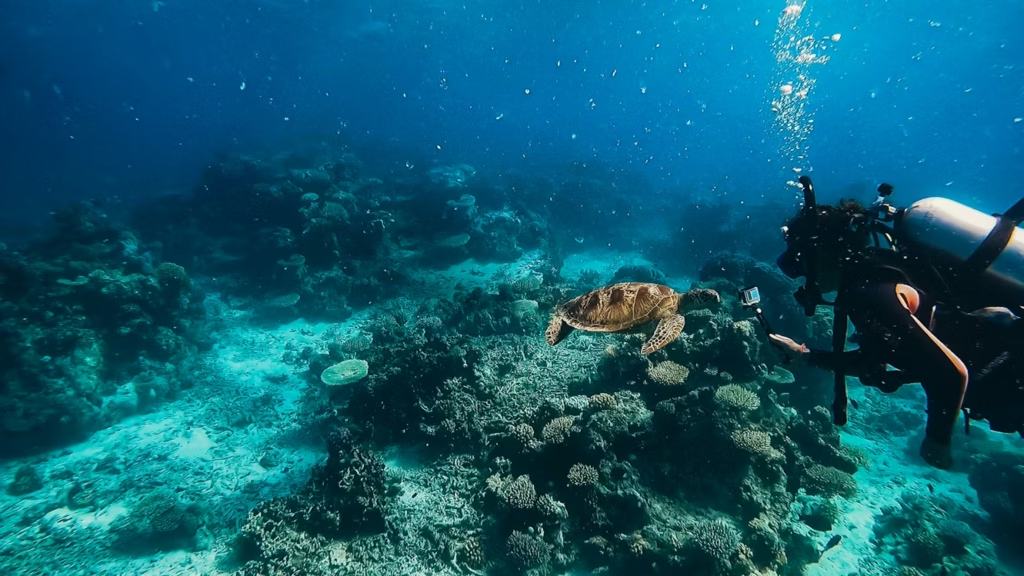
What happens to the gases you breathe while underwater?
In recreational scuba diving, the diver can breathe 2 types of gas mixtures:
- Air: 79% nitrogen + 21% oxygen.
- Nitrox (or EANx = Enriched Air Nitrox): compared to air, has a lower nitrogen content and a higher oxygen content (usually 32% or 36%).
In professional and technical scuba diving, other gas mixtures can be used:
- Heliox: oxygen and helium.
- Trimix: oxygen, nitrogen, and helium.
During a dive, the deeper the diver goes, the greater the pressure on him and the more gases dissolve in his body.
Unlike oxygen, nitrogen and helium are inert gases. That means that, even if they dissolve in body tissues, they are not used for metabolic purposes.
Flying after diving: risks and precautions
A quick ascent during the dive or a flight soon after diving causes a rapid decrease in ambient pressure. This can lead to inert gases forming bubbles in tissues and blood (usually, venous blood).
Gas bubble creation may also occur in the following situations:
- Going to high altitudes after diving.
- Loss of cabin pressure in a plane.
- Depressurisation in a hypobaric chamber.
- Depressurisation in a hyperbaric chamber.
- Space walks.
- Free-diving (rare).
Bubbles can cause a variety of signs and symptoms called Decompression Sickness.
For safety reasons, deep and long dives need a decompression stop during the ascent. It allows the body to reduce the dissolved gas load before reaching the surface.
Also, it takes time for the excess gas to disappear from the body. For this reason, many dives during the day cause dissolved gases to accumulate in the body. This increases the probability of developing Decompression Sickness (and other problems).
Your diving guide, diving instructor, and diving computer will help you stay safe.
Rarely, Decompression Sickness develops even if dive rules are well followed.
Some other factors that increase a person’s risk of developing Decompression Sickness are:
- Dehydration.
- Recent alcohol consumption.
- Cold ambient temperature.
- High body fat content.
- Previous Decompression Sickness.
The DAN organisation has published consensus recommendations for flying after diving:
- At least 12 hours after a single dive that did not need a decompression stop.
- At least 18 hours for multi-day repetitive diving.
- More than 24 hours if the dive needed a decompression stop or you used heliox or trimix.
What are the symptoms of Decompression Sickness?
Signs and symptoms due to Decompression Sickness can involve a variety of body sites.
The scientific community distinguishes 2 categories of Decompression Sickness:
- Type 1: involves the skin, lymphatic system, muscles, and joints. It is not life-threatening.
- Type 2: involves the nervous system, respiratory system, or circulatory system. It may be life-threatening.
A person may develop type 1 and type 2 Decompression Sickness at the same time.
Here are some examples of signs and symptoms based on the involved body site:
- Skin: itching, burning, rash.
- Lymphatic system: swelling of regional lymph nodes, swelling of an arm or a leg.
- Musculoskeletal system: joint and muscle pain, sometimes powerful.
- Brain: blindness, dizziness, paralysis, unconsciousness, convulsion.
- Spinal cord: paralysis, loss of feeling.
- Ear: hearing loss, vertigo.
- Lungs: coughing, shortness of breath, reduced oxygen in the blood (hypoxia).
- Circulation: cardiovascular collapse.
Unusual fatigue and exhaustion after a dive are probably symptoms of Decompression Sickness.
Decompression Sickness usually develops some time after the dive. It could take from minutes to several days for the symptoms to manifest. In rare cases, it develops while diving.
People with a Patent Foramen Ovale (PFO) may also manifest paradoxical gas embolism. Usually, bubbles from the venous circulation dissolve when they reach the lungs. PFO is an anatomic heart variant in which bubbles bypass the lungs and enter arterial circulation. This situation may cause serious damage to many body sites.
What to do in case of Decompression Sickness?
Treating Decompression Sickness is possible. If signs or symptoms of Decompression Sickness develop, seek medical care. The DAN organisation Emergency Hotline is available 24 hours a day for additional assistance.
While waiting for medical intervention, here are some useful tips:
- Don’t take a flight and avoid going to high altitudes.
- If the person is conscious, place the person in a horizontal position.
- If the person is unconscious, place the person in the recovery position.
- If the person is conscious without respiratory problems, drinking water can help. Please avoid other beverages.
- Keep a comfortable body temperature: warm but not hot.
It is highly recommended to have health insurance coverage for diving.
Dive aware, dive safe.
Article written by Dr Debora Podestà, Medical Doctor based in Italy, specialised in Infectious Diseases and Hyperbaric and Diving Medicine
Published on November 24, 2025
Review due on November 24, 2028
Sources
- DAN.org: guidelines for flying after diving;
- Cooper JS, Hanson KC. Decompression Sickness. [Updated 2023 Dec 13]. In: StatPearls [Internet]. Treasure Island (FL): StatPearls Publishing; 2025 Jan-;
- U.S. Navy Diving manual – Revision 7.