
Hepatitis B blood test: serology made simple
Hepatitis B virus (HBV) remains a major global health issue.
To assess whether a person has received the HBV vaccine or has HBV infection, a blood test is available. It is the serology HBV blood test.
Yet, HBV serology can seem complex and challenging to interpret at first.
In this article, you’ll learn HBV serology in a practical and accessible way.
Contents
- What is the Hepatitis B Virus?
- Structure of Hepatitis B Virus
- HBV serology test and HBV-DNA test
- HBV vaccine: serology after vaccination
- Common clinical scenarios
What is the Hepatitis B Virus?
HBV is a virus that infects the human liver.
It is present worldwide but is more frequent in sub-Saharan Africa, East Asia, and the Pacific Islands. In Europe, Eastern and Southeastern countries show the highest number of infections.
Transmission routes
A person can get HBV infection from another person by:
- sharing of needles or other injection equipment
- exposure to infected blood (e.g., razors, tattoo needles, transfusions, organ transplantation)
- sexual contact
- mother-to-child transmission during birth
Types of HBV infection
Based on the time to resolution, HBV infection can be:
- Acute: it lasts <6 months; it is more common in immunocompetent adults. The most severe presentation causes fulminant hepatitis and rapid progression to liver failure. It is uncommon and occurs more frequently in young adults and immunocompromised individuals.
- Chronic: it lasts >6 months. It is the most common type of infection when HBV is acquired at birth or during childhood/adolescence due to immune system immaturity.
HBV is never eliminated from the body. It can persist inside the liver in a dormant state. This condition is called occult HBV infection (OBI). In this setting, the infection doesn’t cause liver injury, and the individual is usually not contagious. Anyway, in case of immune system weakness, HBV may reactivate and cause hepatitis.
Key concept of Hepatitis B Virus infection
Liver injury in HBV infection results from the host immune response rather than from direct viral activity. This is why HBV infection and viral replication are not always associated with hepatitis and liver damage.
In the presence of hepatitis, ALT-GPT (an enzyme produced by the liver) is high on a blood test.
Structure of Hepatitis B Virus
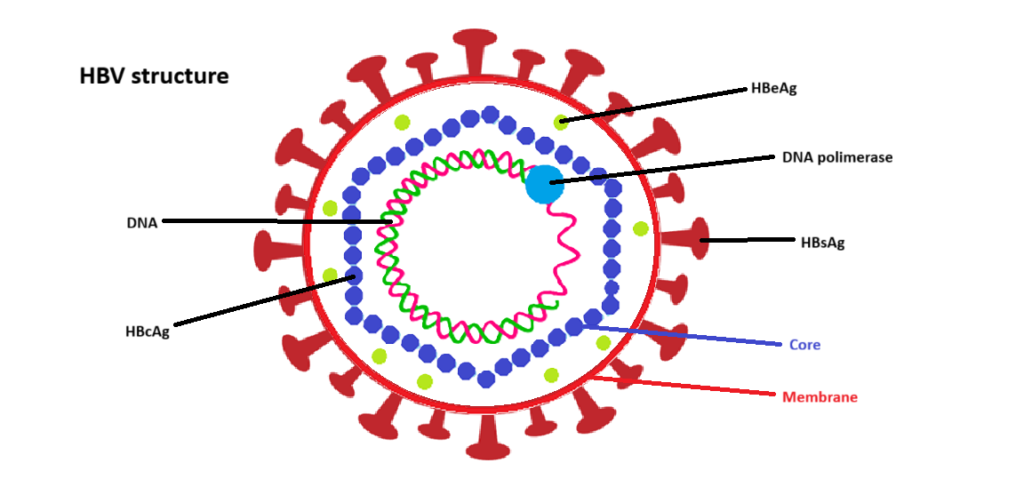
HBV consists of several layers:
- Lipid bilayer membrane: outer surface containing surface antigen (HBsAg).
- Core (capsid): inner shell composed of core antigen (HBcAg).
- Space between membrane and core: may contain the E antigen (HBeAg).
- HBV-DNA: It lies inside the core as a single molecule of circular DNA. It serves as the viral genetic material.
HBV serology test and HBV-DNA test
The HBV serology test is a blood test useful to understand if the person:
- Had a previous vaccination.
- Is infected by HBV, and if the infection is active or occult.
- Did not receive a vaccination, nor get infected with HBV.
It examines HBV antigens and anti-HBV antibodies.
In particular:
- HBsAg: hepatitis B surface antigen
- Anti-HBs: antibodies against hepatitis B surface antigen
- Anti-HBc: antibodies against hepatitis B core antigen. It comprises anti-HBc IgM and anti-HBc IgG antibodies. It is also possible to test only anti-HBc IgM (see under)
- HBeAg: hepatitis B E-antigen
- Anti-HBe: antibodies against hepatitis B E-antigen
Another important blood test to assess the person’s situation is the HBV-DNA test. It measures HBV-DNA levels in the blood.
HBsAg
Characteristics:
- Is a structural viral protein, located on the surface of the virus, in the lipid membrane.
- Indicates active HBV infection (acute or chronic).
- Is absent in occult HBV infection.
Anti-HBs
Characteristics:
- Are produced by the immune system.
- Appear after resolution of a natural active infection and the decline in HBsAg, or after vaccination.
- Protect from a new HBV infection.
- Can be given intravenously for immediate protection from HBV infection. They last 4-6 months.
Anti-HBc
Characteristics:
- Are produced by the immune system around 1-2 months after infection.
- Appear in response to HBV infection.
- Usually persist for life.
- Are not produced after vaccination.
- The assay detects both anti-HBc IgM and anti-HBc IgG antibodies.
Anti-HBc IgM
Characteristics:
- Are produced by the immune system around 1-2 months after infection.
- Appear in response to HBV infection.
- Disappear around 32 weeks after infection.
- Useful to assess acute HBV infection.
HBeAg
Characteristics:
- Is a secreted viral protein.
- Is produced by wild-type variants of HBV. Some HBV variants don’t produce it.
- Is associated with high viral replication and high infectivity.
- Is common in the early phases of infection.
- Emerging evidence suggests it has immunomodulatory roles, influencing host tolerance to infection.
Anti-HBe
Characteristics:
- Are produced by the immune system months after infection and after HBeAg decline.
- Appear in response to E-antigen-producing HBV infection.
- Are not produced after vaccination.
- Are often associated with reduced viral replication.
HBV-DNA
Characteristics:
- Is the viral genetic material present in the blood.
- Indicates and quantifies viral replication and infectivity. The higher the HBV-DNA titre, the more the virus replicates, and the more infectious the person is.
HBV vaccine: serology after vaccination
HBV vaccination began in the 1980s. Since then, HBV transmission has decreased a lot. New generations (second and third) of HBV vaccines are available nowadays.
The serology test of a person who has received the vaccination and has responded to it shows:
- anti-HBs titre > 10 mIU/mL.
- HBsAg, anti-HBc, HBeAg, anti-HBe: negative.
To be reliable, the serology test needs to be done at least 1–2 months after completing all the vaccine doses.
Anti-HBs levels may decline over time, yet immune memory generally persists in healthy individuals.
Common clinical scenarios
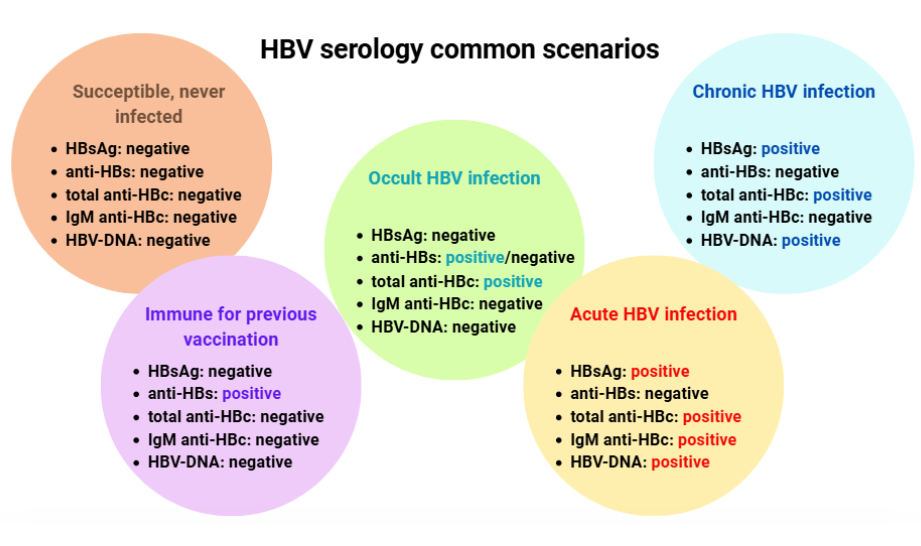
Let’s now explore how different combinations of HBV markers appear in common clinical scenarios.
Article written by Dr Debora Podestà, Medical Doctor based in Italy, specialised in Infectious Diseases and Hyperbaric and Diving Medicine
Published on November 25, 2025
Review due on November 25, 2028
Sources
- EASL Clinical Practice Guidelines on the management of hepatitis B virus infection Cornberg, Markus et al. Journal of Hepatology, Volume 83, Issue 2, 502 – 583
- Moroni, Mauro; Antinori, Spinello; Vullo, Vincenzo; Mastroianni, Claudio Maria. Manuale di malattie infettive – 3 ed. (Italian Edition) (p.414). Edra. Edizione del Kindle.
- Conners EE, Panagiotakopoulos L, Hofmeister MG, Spradling PR, Hagan LM, Harris AM, Rogers-Brown JS, Wester C, Nelson NP; Contributors. Screening and Testing for Hepatitis B Virus Infection: CDC Recommendations – United States, 2023. MMWR Recomm Rep. 2023 Mar 10;72(1):1-25. doi: 10.15585/mmwr.rr7201a1. PMID: 36893044; PMCID: PMC9997714.